|
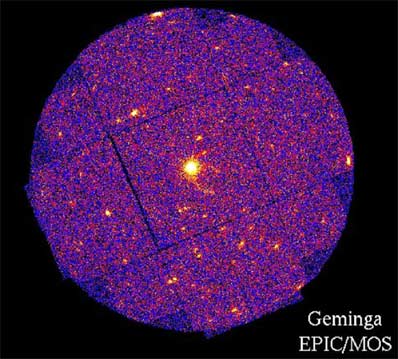
Using the X-ray satellite XMM-Newton, astronomers have been able to
study how three pulsars - rapidly rotating neutron stars - emit part
of their radiation from very hot spots on the surface. The
news
is based on a paper
published in The Astrophysical Journal, and shows how different the three
studied pulsars are. The hot spots on the surface of the neutron stars are
sometimes as large as football fields, but in another case the size of
a complete golf course. By studying how the thermal radiation from these
spots vary in time, astronomers try to understand how the radiation
from the pulsars arises.
At Stockholm Observatory, research on pulsars is conducted in the
supernova group. The group has recently studied one of the pulsars
mentioned above using the Hubble telescope. The study shows that the
ultraviolet radiation from the pulsar is not at all dominated by thermal
radiation from the surface of the neutron star - instead it arises in the
very strong magnetic field surrounding the pulsar.
|