
The infrared heart of a GRB

|
|
The infrared heart of a GRB |
|
|
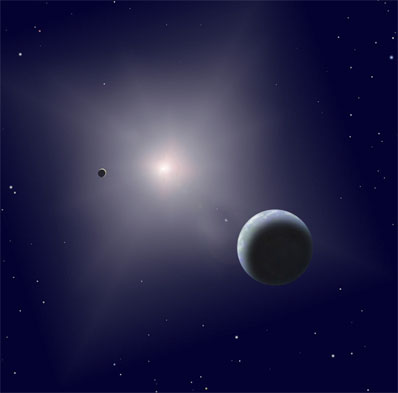
On December 19, 2004 the INTEGRAL-satellite detected a powerful gamma-ray burst (GRB) in the constellation of Cassiopeia. The NASA-satellite Swift also detected the burst, and could broadcast its position on the sky to astronomers around the globe. The fast positioning enabled a fully automated IR-telescope to observe the early emission of the GRB - observations started only 7.2 minutes after the satelittes detected the burst - for the first time. The PAIRTEL-telescope in Arizona detected infrared radiation from the GRB during the early emission. Read the press release here. The results from the observations are published in the latest issue of the scientific journal Nature, and will further contribute to the emerging picture of how gamma-ray bursts arise. Scientists believe that the early emission arises after a powerful type of supernova explosion, triggered by the collapse of a massive star. A relativistic outflow is created by the explosion, where electrons are accelerated almost to the speed of light. Processes in the outflow emit X-ray and gamma-ray radiation, and can also give rise to infrared emission. The new IR-observation will add to the knowledge of the radiation mechanisms and the physics of the emitting region, something which is not yet fully understood. The observation is therefore both important and exciting. At Stockholm Observatory, astronomers in the high energy astrophysics group work with precisely these radiative processes, together with the supernova group. The astronomers are also involved in observational programs with both the INTEGRAL and Swift satellites. |
| Contact : | |
| Felix Ryde | Tel: 5537 8545 |
| Stefan Larsson | Tel: 5537 8543 |