
Shocked supernova still a mystery

|
|
Shocked supernova still a mystery |
|
|
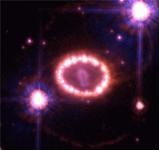
Supernova (SN) 1987A continues its beautiful display as it collides with the ring-like structure around it. The collision can be seen in all wavelengths from radio to X-rays, and the image is an optical view from the Hubble Space Telescope (HST), giving a detailed look at where the explosion is most intense. While the emission is intense in the outer parts of the supernova shell, there is remarkably little emission in the center of the supernova. During the explosion on February 23, 1987 neutrinos were detected from the creation of a neutron star in the center, but since then the central object has kept itself hidden. Is it still a neutron star or has the collapse continued to a black hole? This is not yet known. In an article by Graves et al. HST was used to search for a possible neutron star or a black hole, but nothing was found. The supernova group in Stockholm has with the aid of the ground-based ESO Very Large Telescope studied in very high spectral resolution how the supernova shocks the surrounding ring. The results clearly show how extremely high temperatures are created by this cosmic collision. |
| Contact : | |
| Peter Lundqvist | Tel: 5537 8518 |
| Per Gröningsson | Tel: 5537 8553 |
| Claes Fransson | Tel: 5537 8517 |
