
Breakthrough regarding short GRBs

|
|
Breakthrough regarding short GRBs |
|
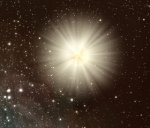
New observations made in the past few months show that short gamma-ray bursts (GRBs) are very powerful explosions from the distant universe, but that they probably are not related to long GRBs, which stem from supernova explosions. Jesper Sollerman of Stockholm University is co-author of two articles in the latest issue of the scientific journal Nature , where the most important results have been published.
Gamma-ray bursts, showers of highly energetic radiation from space, have been observed for over 30 years (link to article in the Swedish journal Populär astronomi here). Three years ago, Jens Hjorth at the Dark Cosmology Center at the University of Copenhagen and Jesper Sollerman at Stockholm University, together with a large number of international colleagues, showed that long GRBs really are connected to supernova explosions (link to the article in Nature here and to ESOs press release here).
But the origin of the short GRBs, which last for only a fraction of a second, has not been known. It was not until May of this year that a short GRB was localized with reasonable precision. The flash turned out to originate in an area of the sky close to an old elliptical galaxy. The GRB does not appear to have any connection to the young and massive stars which explode as supernovae. Short GRBs therefore seem to be something else entirely. The results are published in the latest issue of Nature and in a follow-up study in Astrophysical Journal Letters by Jens Hjorth and Jesper Sollerman with colleagues.
In July this year, astronomers were able to capture the very first image in visible light of a short GRB. Using the Danish 1.5-meter telescope in Chile, Jens Hjorth, Jesper Sollerman and their collaborators were able to see the long sought-after afterglow to a GRB detected on July 9. The breakthrough and subsequent analysis, once again showing that no supernova explosion is involved, are also published in the latest issue of Nature, dominated by the new results concerning short GRBs.
The most popular theory about the origin of short GRBs is currently the hypothesis that two very compact stars, such as neutron stars, collide and form a black hole.
| Contact : | |
| Jesper Sollerman | jesper@astro.su.se |