
The First Light

|
|
The First Light |
|
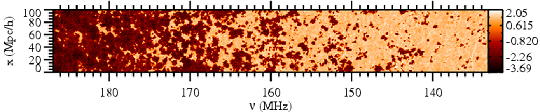
Top: The predicted 21cm signal based on new CMB measurements.
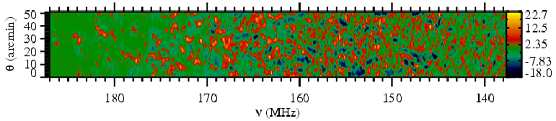
Bottom: Simulation of what might be measured by the radio observatory LOFAR.
Colors indicate fluctuations around the mean temperature. Credit: Garrelt Mellema & Ilian Iliev.
A new study shows that it could be easier than expected so far to detect the radiation emitted by the first stars in the universe.
Early in the history of the universe, about 13 billion year ago, the first galaxies must have formed. We cannot yet observe these galaxies with current telescopes, but in the next five years we hope to detect the signpost of these early galaxies, by mapping the effect the radiation of their stars has on the gas between the galaxies, an effect known as reionization. This will be done by observing at radio wavelengths. Previous models showed that this would be a very difficult measurement, with much of the interesting information located between radio frequencies of 90 and 110 MHz, a range that is heavily used for FM radio broadcasts here on Earth.
New models calculated by Garrelt Mellema from Stockholm Observatory together with an international team of researchers from Canada and the US, now show that the best frequency range to observe is 140 to 180 MHz. This will make the observations much easier to do. These new models use the latest data from the WMAP satellite. The same team also calculated the (small) effects of the reionization process on measurements of the Cosmic Microwave Background. This will be important for interpreting future observations of this background.
| Contacts: | |
|---|---|
| Garrelt Mellema | Tel: 08-5537 8552 |