
Supernova 1987A: An astrophysical laboratory

|
|
Supernova 1987A: An astrophysical laboratory |
|
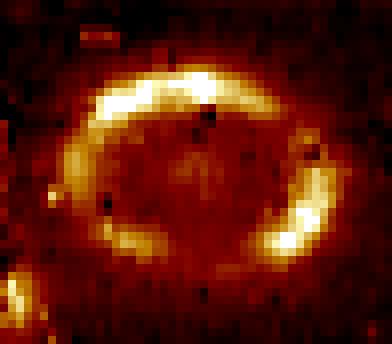
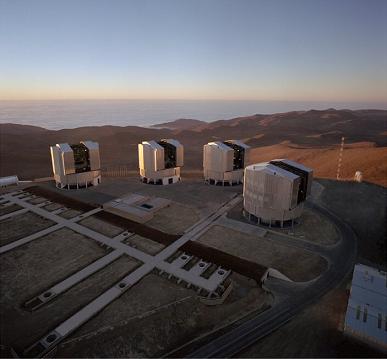
Left: Supernova 1987A and its ring structure observed in infrared. Credit: K. Kjaer, ESO 2005. Right: Very Large Telescope (VLT) in Chile. Credit: European Southern Observatory (ESO).
The Supernova Group at Stockholm Observatory has with the help of ESO's Very Large Telescope (VLT) in Chile been able to carefully study different regions of the gas surrounding the supernova.
With today's modern telescopes and the relatively short distance of about 160 000 lightyears, observations of Supernova 1987A offer a unique opportunity to obtain detailed information on the physical processes that take place after the explosion of a massive star. The Supernova Group at Stockholm Observatory has for several years, for example with the help from data from VLT, followed the evolution of Supernova 1987A.
The collision between the outer shell of the supernova and the gas surrounding it is now in full swing. In this violent collision the surrounding gas is shocked, which gives rise to strongly increased emission in all wavelength regions. Thanks to spectroscopy with high resolution at optical wavelengths, it has been possible to separate shocked gas from the non-shocked gas and study these regions individually. This has allowed for a careful investigation of the interaction between the supernova and the surrounding gas. The results from this study are presented in a new article by Gröningsson et al..
Supplementary observations in infrared from VLT are presented in an article by Kjaer et al.. These observations are done with so-called adaptive optics, which allow a very high spatial resolution. This high resolution has made it possible to study individual shock regions and to among other things determine the geometry of the surrounding ring structure (see the image above).
| Contacts: | |
|---|---|
| Per Gröningsson | Tel: 08-5537 8553 |
| Claes Fransson | Tel: 08-5537 8517 |
| Peter Lundqvist | Tel: 08-5537 8518 |