
Doctoral dissertation on gamma-ray bursts by Luis Borgonovo

|
|
Doctoral dissertation on gamma-ray bursts by Luis Borgonovo |
|
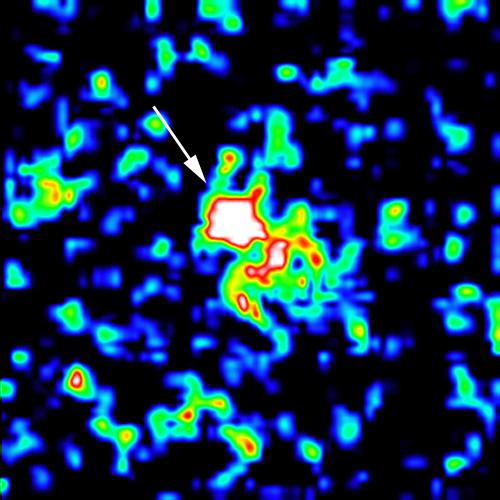
The optical afterglow of the gamma-ray burst of February 28, 1997. The afterglow is the large white blob close to the image center (indicated by the arrow), and the roughly "E" shaped extended object immediately to the lower right is the host galaxy. The picture is a combination of two photographs obtained by the Hubble Space Telescope in visibile light. The colors in the reproduction indicate the brightness, rather than the actual color. Credit: K. Sahu, M. Livio, L. Petro, D. Macchetto, STScI and NASA.
On May 16, Luis Borgonovo defends his doctoral thesis titled "Spectral and temporal studies of gamma-ray bursts".
Gamma-ray bursts (GRBs) are sporadic flashes of light observed primarily in the gamma-ray band. Being the brightest explosions in the Universe since its birth, they are also some of the furthest astronomical sources detected. Since their serendipitous discovery in the late 1960s the study of GRBs has grown into one of the most active fields in astrophysics with ramifications in many other scientific areas.
Despite intense studies many of the basic questions about the nature of GRBs remain unanswered. Long duration bursts are believed to be the result of ultra-relativistic outflows associated with the collapse of very massive stars. The mechanisms responsible for the emission, the geometry of the emitter, and the radiative processes involved are still a matter of research. Common multi-pulse bursts display a spectral evolution as complex as their light curves. However, it is unclear what produces the observed variability. The works presented in this thesis aim to build the necessary base to answer these open questions. For more information, see the Stockholm University's thesis information.
Time: Wednesday, May 16, 13.15
Place: FA32, AlbaNova University Center, Roslagstullsbacken 21
| Contacts: | |
|---|---|
| Luis Borgonovo | Tel: 08-5537 8546 |