
What is going on in debris disks?

|
|
What is going on in debris disks? |
|
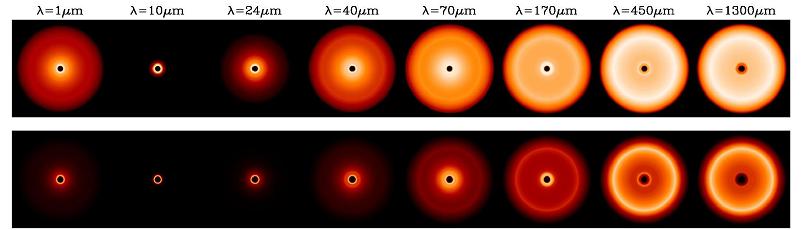
Synthetic images, reconstructed from the numerical results, of a typical extended debris disk at different wavelengths (each wavelength is preferentially tracing the distribution of particles of a given size range, and, for IR images, at a given distance from the star). Credit: Philippe Thébault.
An international research team has developed a new model for the dusty disks left over after planet formation.
Debris disks around young (and not so young) stars have been imaged for more than 20 years (see a nice family portrait of debris disks). They are believed to be the leftover solid matter remaining in these systems once planets have formed. Paradoxically, what can be seen from these disks are only the smallest dust particles, typically a few microns to a few millimetre in sizes, because these are the ones which intercept most light from the star. However, it is known for sure that these dust grains cannot be primordial: they have to be constantly produced, by collisions, from bigger objects which are unfourtunately impossible for us to detect. Reconstructing these vast populations of unseen grains, pebbles, rocks and planetesimals from this very limited information about micron-to-mm sized dust is a real challenge.
A joint research team of Stockholm Observatory and Grenoble University has developed a new numerical model, aimed at following the global collisional evolution of such large debris disks. Their results, presented in a new article by Philippe Thébault et al., lead to a new understanding of what is going on in these systems. In particular, the complex link between micron-sized dust observed in visible light, bigger grains detected in Infra-Red and the vast population of unseen "parent bodies" has been quantified. These studies will be of great help for the bevy of new observational data awaited from new space facilities such like Herschel.
| Contacts: | |
|---|---|
| Philippe Thébault | Tel: 08-5537 8559 |