
A factory for massive stars

|
|
A factory for massive stars |
|
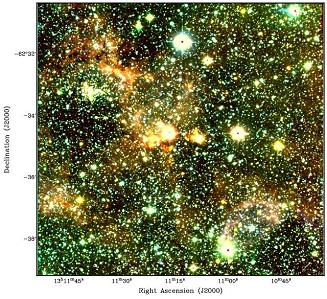
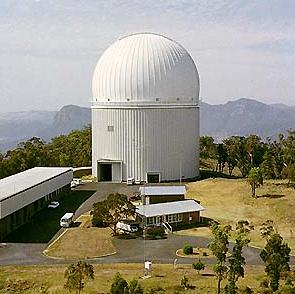
Left: Star forming region G305.2+0.2. Credit: Matthias Maercker. Right: 4m Anglo-Australian Telescope. Credit: Anglo-Australian Observatory.
A collaborating group of researchers from Stockholm Observatory and the massive star formation group at the University of New South Wales (UNSW) in Sydney, Australia, has taken a closer look at a stellar factory for massive stars.
Star formation is one of the biggest and most active fields within astronomy today, trying to explain the formation of the most obvious objects on the night sky to the naked eye - the stars. In particular, in the field of massive star formation (stars in excess of approximately ten solar masses) many unanswered questions still remain.
In May 2006, Sofia Ramstedt and Matthias Maercker (both PhD students with the AGB group at Stockholm Observatory), together with Steven Longmore (currently finishing his PhD at UNSW), obtained deep infrared images of three massive star forming regions using the 4m Anglo-Australian Telescope (AAT) at Siding Spring Observatory outside Coonabarabran in New South Wales, Australia. Combined with longer wavelengths data from the GLIMPSE project aboard the Spitzer Space Telescope, the data for the first region, G305.2+0.2, will be published this summer in an article by Longmore et al. in the Monthly Notices of the Royal Astronomical Society (MNRAS).
The G305.2+0.2 complex lies at a distance of 11 000 to 13 000 lightyears from the Sun and is a large (about 300 lightyears in extent) region of recent and ongoing star formation. About 3-5 million years old, the region is one of the most luminous HII regions in the Galaxy containing an excess of 31 O-type stars.
The analysis of the AAT and Spitzer data shows a possible third generation of star formation triggered by the winds of the OB association G305.24+0.204. The distribution of sources with excess in infrared around the cluster and in the cluster centre, and the distribution of sources with excess in infrared offset from the known sites of star formation also indicate signs of recent massive star formation and a more widespread star formation than previously thought. This may give important insights into how and where massive stars form.
The data was obtained as an observational project that was part of Sofia's and Matthias' graduate program. The contact between Stockholm Observatory and UNSW will continue with undergraduate students from Stockholm visiting UNSW to work on the data on the remaining two regions.
| Contacts: | |
|---|---|
| Matthias Maercker | Tel: 08-5537 8550 |
| Sofia Ramstedt | Tel: 08-5537 8550 |