
Destroying ice in young solar systems

|
|
Destroying ice in young solar systems |
|
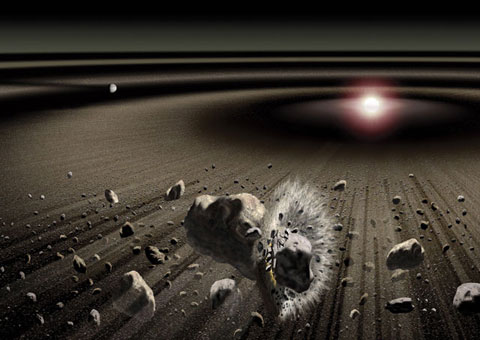
Depiction of a possible planet (upper left) flanked by bands of dust within the debris disk surrounding the star Beta Pictoris (upper right). Credit: Kouji Kanba, ISAS/JAXA.
A new study at Stockholm Observatory shows that stellar radiation may blast away water ice even in the outer, cooler parts of circumstellar discs.
Our planet was formed from dust orbiting the Sun during its early stages of evolution, when a circumstellar disc consisting of gas and dust was created. Such discs have in recent years been detected around other stars. Do they reflect our own solar system's distant past? This question has triggered intense studies of dusty discs around other stars.
An important property in this context is the composition of the solid material in these discs. Spectroscopic observations have revealed the presence of silicates in some discs. Other constituents are more difficult to directly observe and therefore open for speculation. The conventional picture assumes that rocky material dominates the inner part of a circumstellar disc, while the grains of the outer parts of the disc are icier. The reason is that the ice, expected to mainly consist of water, easily gets evaporated by the heat from the nearby star. This limits the region where ice can survive to the outer, cooler parts of the disc.
A new article by Grigorieva et al. shows that, in some circumstances, ice may not survive even in those distant regions. At the late stage of disc evolution, the disc becomes transparent to the stellar radiation. Energetic ultraviolet radiation penetrating the disc out to large distances efficiently blasts away exposed water ice in a process called photosputtering, or photodesorption. Applying the analysis to the archetypical debris disc system of Beta Pictoris showed that solids in this particular system cannot contain a significant fraction water ice, even hidden in big objects. In a debris disc system, like the one around Beta Pictoris, boulders are constantly grinded down to dust, so that fresh surfaces of ice would be vulnerable for the photosputtering process. This process would produce oxygen at a rate so high that it would contradict existing observations of the oxygen content in the disc. The main conclusion is that water ice cannot be a dominant constituent of the dust in Beta Pictoris. This work shows that it is possible to put constraints on the composition of dust in distant systems by theoretical studies combined with laboratory data.
| Contacts: | |
|---|---|
| Anna Grigorieva | Tel: 08-5537 8551 |