
Bigger is not always better

|
|
Bigger is not always better |
|
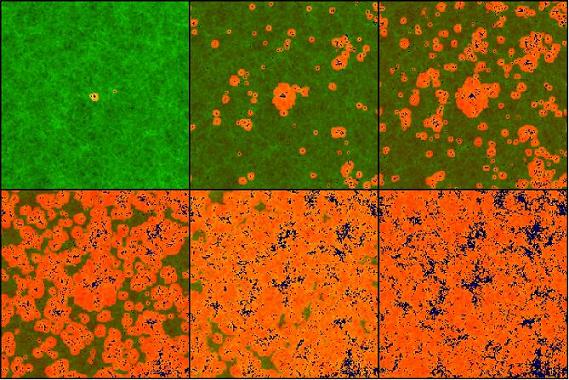
The reionization history around the largest galaxy found in the simulation (from upper left to lower right). This galaxy is placed in the middle of the pictures. The images show how the ionized region (orange) grows around this galaxy, but also that it slowly gets surrounded by a multitude of smaller galaxies (blue dots) who together are much more important for the growth of the ionized region. Credit: Garrelt Mellema.
An international research team has simulated how the radiation from the first stars affected the evolution of the universe.
Early in the history of the universe, about 13 billion year ago, the radiation from the stars in the first generation of galaxies ionized the gas between the galaxies, an effect known as the reionization of the universe. Researchers all over the world are working on trying to understand this process, as it is important for the subsequent evolution of galaxies in the universe. Some of the galaxies from the era of reionizaton are (with much effort) directly observable with the largest telescopes on Earth, and researchers have tried to use the properties of these galaxies to understand the process of reionization.
New numerical simulations of reionization by Garrelt Mellema from Stockholm Observatory together with an international team of researchers from Switzerland, Canada and the US show that the galaxies we can observe are the exceptionally bright ones, and that their effect on reionization is marginal compared to the multitude of smaller galaxies which we cannot yet observe. Also, these bright galaxies live in special regions in the universe. Using them to understand reionization may lead to wrong results when not taking their special properties and environments into account.
| Contacts: | |
|---|---|
| Garrelt Mellema | Tel: 08-5537 8552 |