
New glasses reveal secrets in spiral galaxy center

|
|
New glasses reveal secrets in spiral galaxy center |
|
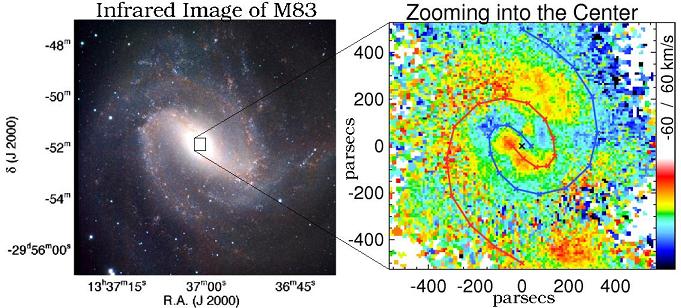
The spiral galaxy M83 together with a velocity map showing the inflow of gas along an unforeseen nuclear spiral structure. Red means redshift and blue indicates blueshift, in the frame of the galaxy. Credit: ESO's 1.54 meter Danish telescope, Andreas Andersson Lundgren & Tommy Wiklind (left), Kambiz Fathi and the GHaFaS-team (right).
With the help of a revolutionary instrument, an international research team has mapped the gas flow feeding the nuclear starburst in the galaxy M83.
In July 2007, a new astronomical instrument, the Fabry-Perot interferometer called GHaFaS (Galaxy H-alpha Fabry-Perot System), saw its first light at the 4.2 meter William Herschel Telescope on the island of La Palma, Spain. GHaFaS (which sounds like the Spanish word "gafas", for a pair of glasses) covers a field of view of 4.8 arcminutes (diagonal) and has an unprecedented spatial resolution of 0.2-0.4 arcseconds per pixel. It has been specially designed to primarily study the Hα emitting interstellar gas in nearby galaxies.
The first scientific result with GHaFaS has shown the unprecedented power of the instrument, where interstellar gas was mapped to within 9 parsecs per pixel (29 light years per pixel at the distance of M 83) in the well known nearby spiral galaxy M83. In a new article by Kambiz Fathi from Stockholm Observatory and collaborators, these observations are presented which reveal that the velocity field in M83 displays the dominant disk rotation with signatures of gas inflow from distances of thousands of parsecs down to the nuclear regions. It was also seen that a rapidly rotating disk of about 550 million solar masses and with scale length of 60 parsecs has formed in the center of the main galaxy disk.
These kinematic features show that the region within 300 light years radius of the nucleus of M83 is dynamically fed by gas from the outer parts of the galaxy, containing many young and bright stars which make is difficult to clearly see the morphology of the nucleus. Thus the nuclear star forming region hosts several bursts caused by varying inflow rate of the disk material onto the starburst. It is estimated that the nuclear starburst in M83 contains at least a few tens of millions solar masses of stars.
GHaFaS was produced by a team from the Université de Montréal (Canada), with partners at the Instituto de Astrofísica de Canarias (Spain) and the Observatoire de Marseille (France).
| Contacts: | |
|---|---|
| Kambiz Fathi | Tel: 08-5537 8542 |