General ODIN information Go To ODIN Home Page at SSC
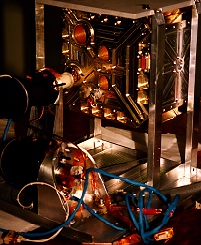 Cryostat
& Space Cooler
Cryostat
& Space Cooler
The ODIN Cool Box (Cryostat) developed by ACR and SOS.
The design process of the ODIN Cool Box contains two conflicting demands
- high stability versus high thermal
insulation. In order to achieve these goals the inner structure is suspended
with kevlar fibres. Very low thermal
conductivity combined with high strength for the fibres makes this a possible
solution.
According to launch specification for the satellite, the thickness of
the kevlar suspension was chosen in such a way
that the lowest resonance frequency was forced up to the 150 Hz region. For
these calculations I used ANSYS FEM
program.
A test cryostat was vibrated to a 10 g level to check performance of the
suspension. The permanent displacement
after the vibrational testing was surprisingly low - less than one tenth
of a millimeter. This was measured by a laser
diode reflex in the cool box.
The noble art of wrapping a space cryostat. About
30 layers of M.L.I. (Multi Layer Insulation) are wrapped around
the inner box .
One of the biggest heat contribution come from three major openings for
the signals.In order to reduce radiation
losses kevlar baffles were used. The thermal performance and integration
to the space cooler from B.A
(British Aerospace) was tested at SSC (Swedish Space Corporation) in a
vacuum chamber. We reached about
120-130 K with full heat-load.
The cooler could lift about 2W at 100k.
General cryocooler information page at NASA .