SVISS Supernova candidates, third screening
The total number of candidates in the different quadrants are:
B1: 7 (2)
A2: 8 (2)
A3: 4 (2)
B4: 1
New stuff in this version:
Cutouts and lightcurves only shown for uncertain candidates (the
number of uncertain candidates are shown in paranthesis above).
For each candidate the following information is available:
- Identification number and quadrant (e.g. a2-12)
- Best fitting template
- Best fitting parameters with the above template,
MB(peak) is the fitted absolute magnitude at peak,
zfit is the fitted redshift of the SNe, te
is the teomporal offset in days between the explosion date and the
first search epoch and extmod is the extinction model (1-7 Cardelli
with RV=3.1, 8-14 Cardelli with RV=2.1 and
15-21 Calzetti and E(B-V) from 0 to 0.6 for each).
- Fitting quality (P/L/chisq) for the above template
- Host galaxy magnitude, mI(host)
- Host photometric redshift, zp (1 sigma uncertainty)
- Comments (my comments on the data and fit quality)
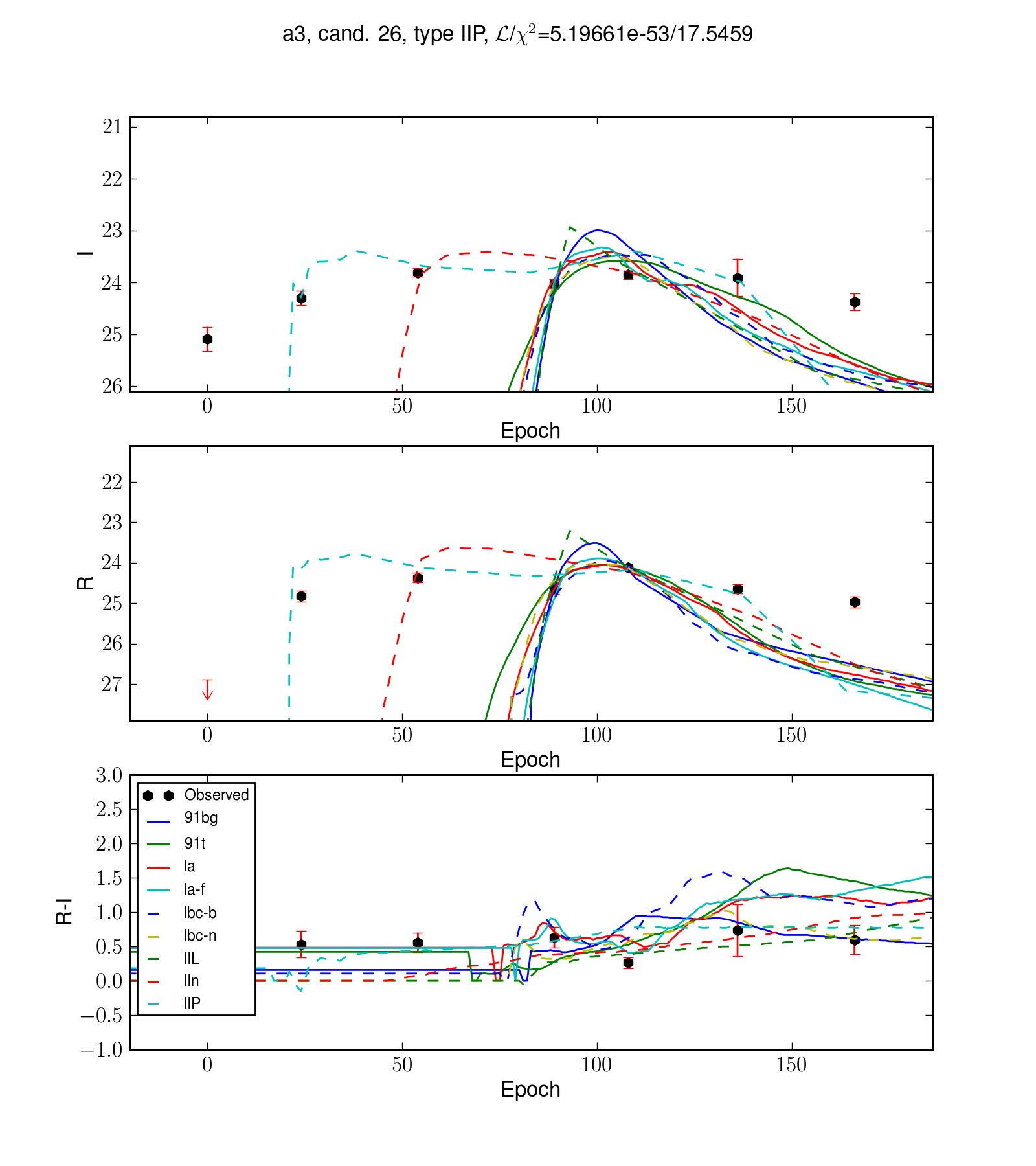
- A panel with the observed light curve plot (R, I, R-I) and the
best fit light curve for each template.
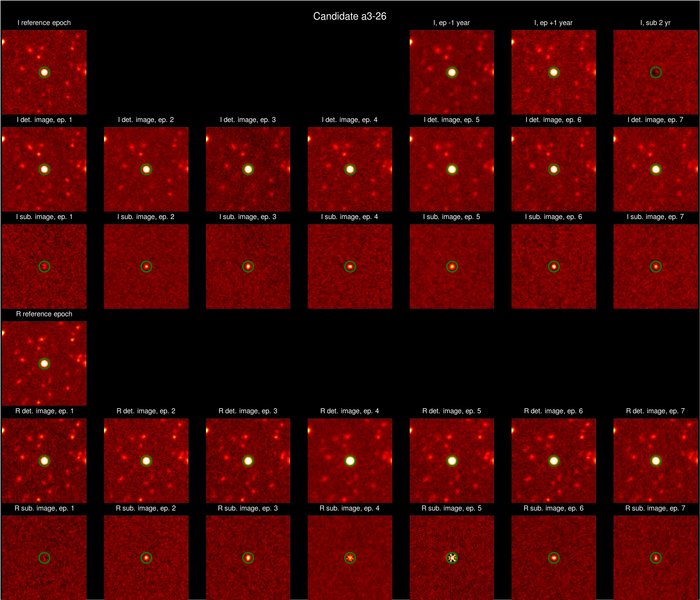
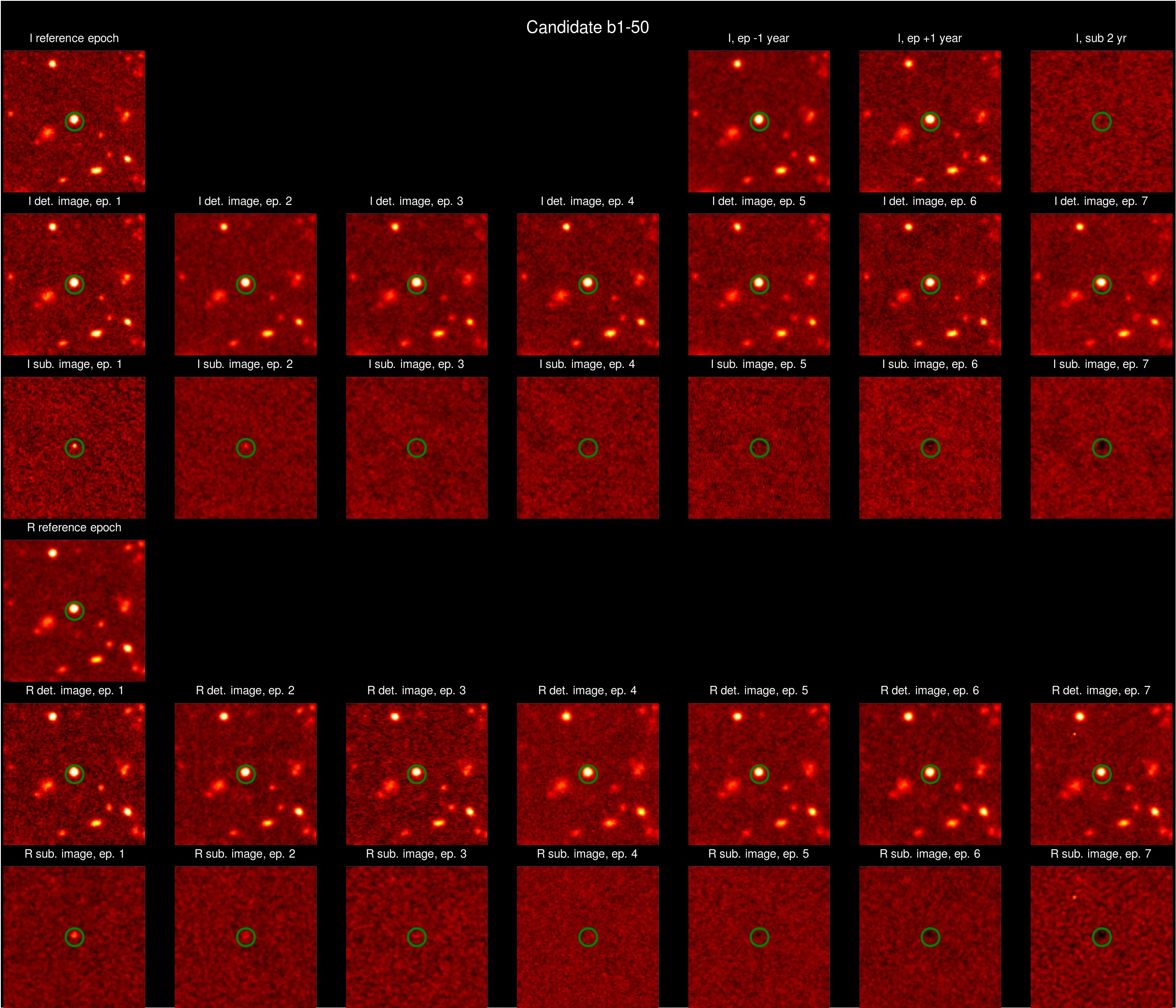
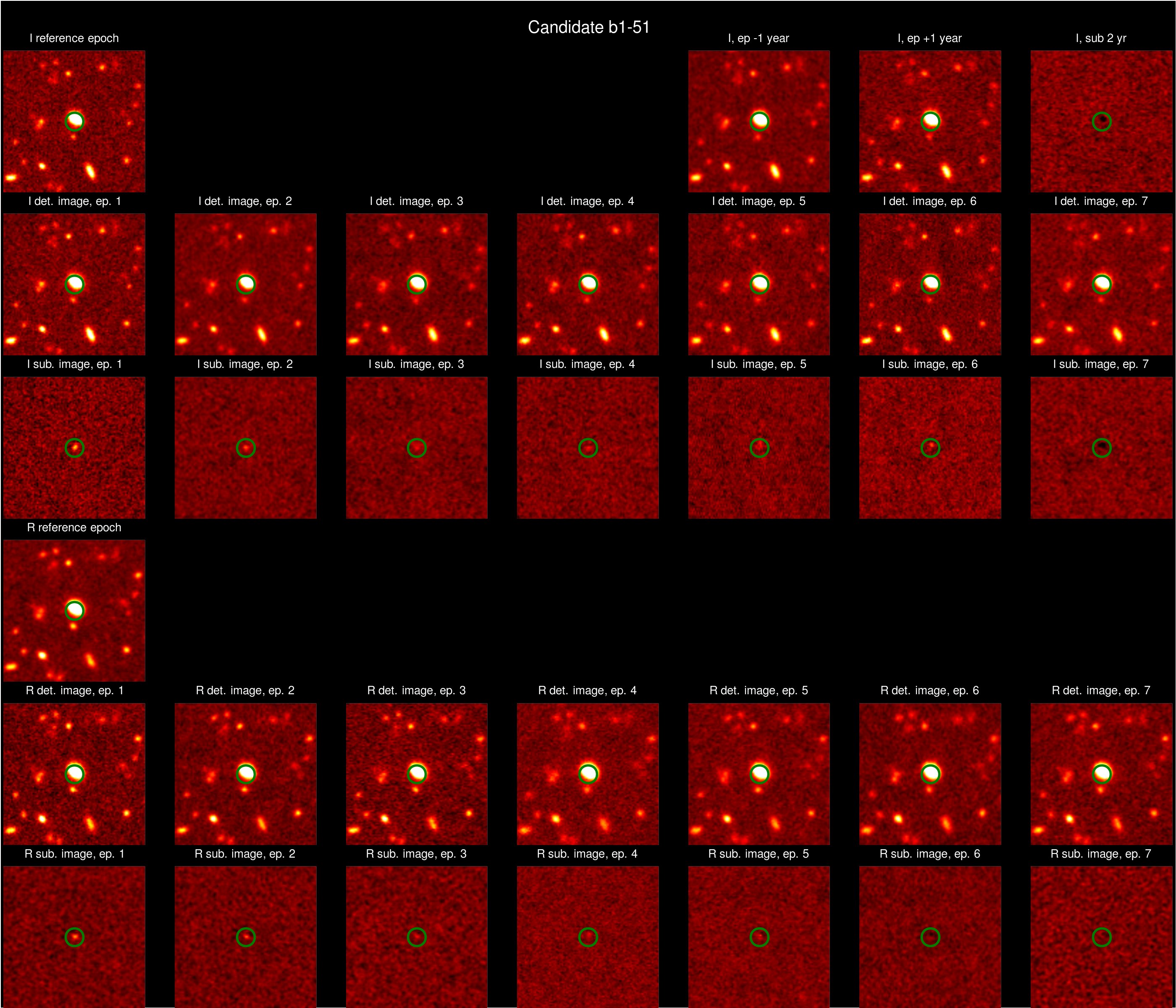
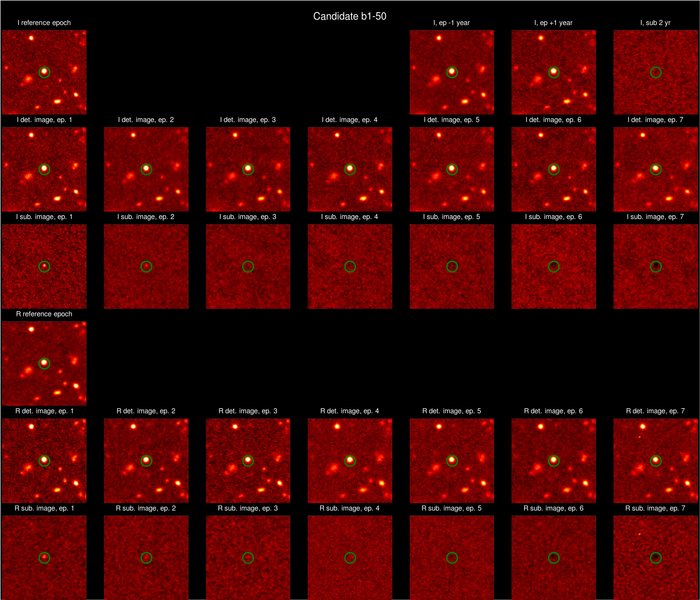
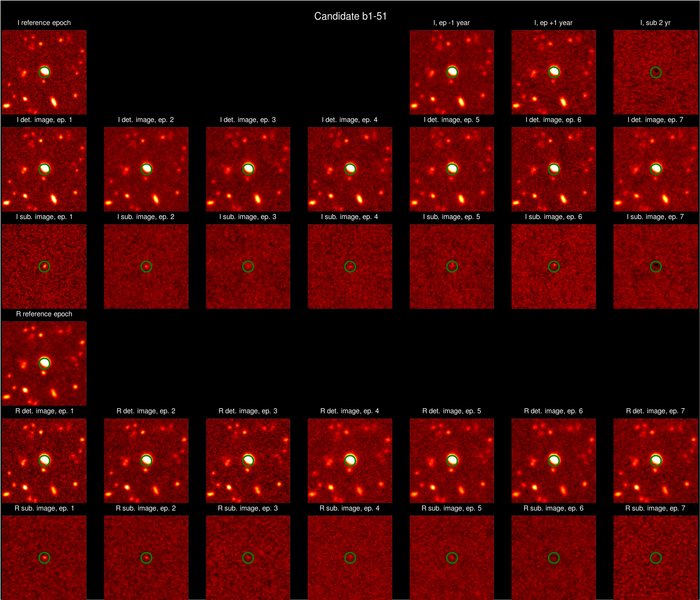
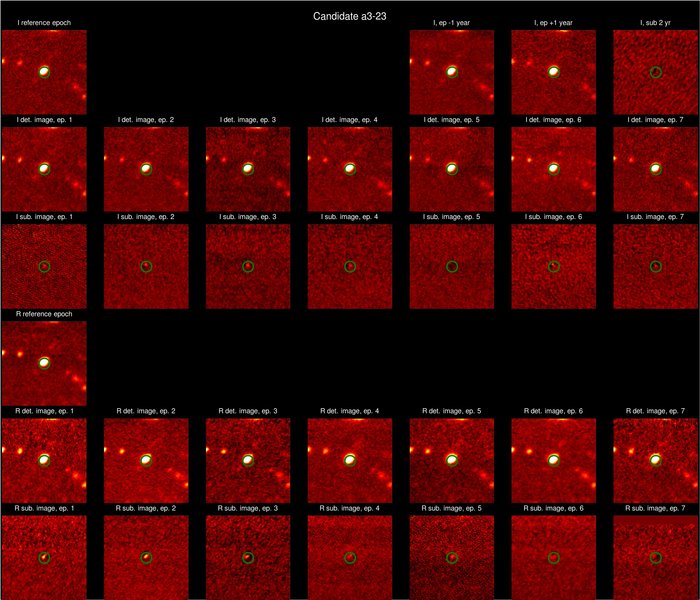
- A panel with the image stamps, containing the reference image,
the seven detection images and the seven subtracted images.
Ratings:
- A, primary SN candidate
- B, secondary SN candidate, typing questionable/difficult
- X, not a supernova, likely AGN
- 0, not a supernova, likely nothing
Please give me your comments on each of the problematic six. The
rest (14) have been designated A or B by all of us, those I will
include. The final 11 ones have been designated 0 or X by almost all
of us (in some cases there is one differing opinion, but if there's
more than one it's in the problematic list).
B1 quadrant
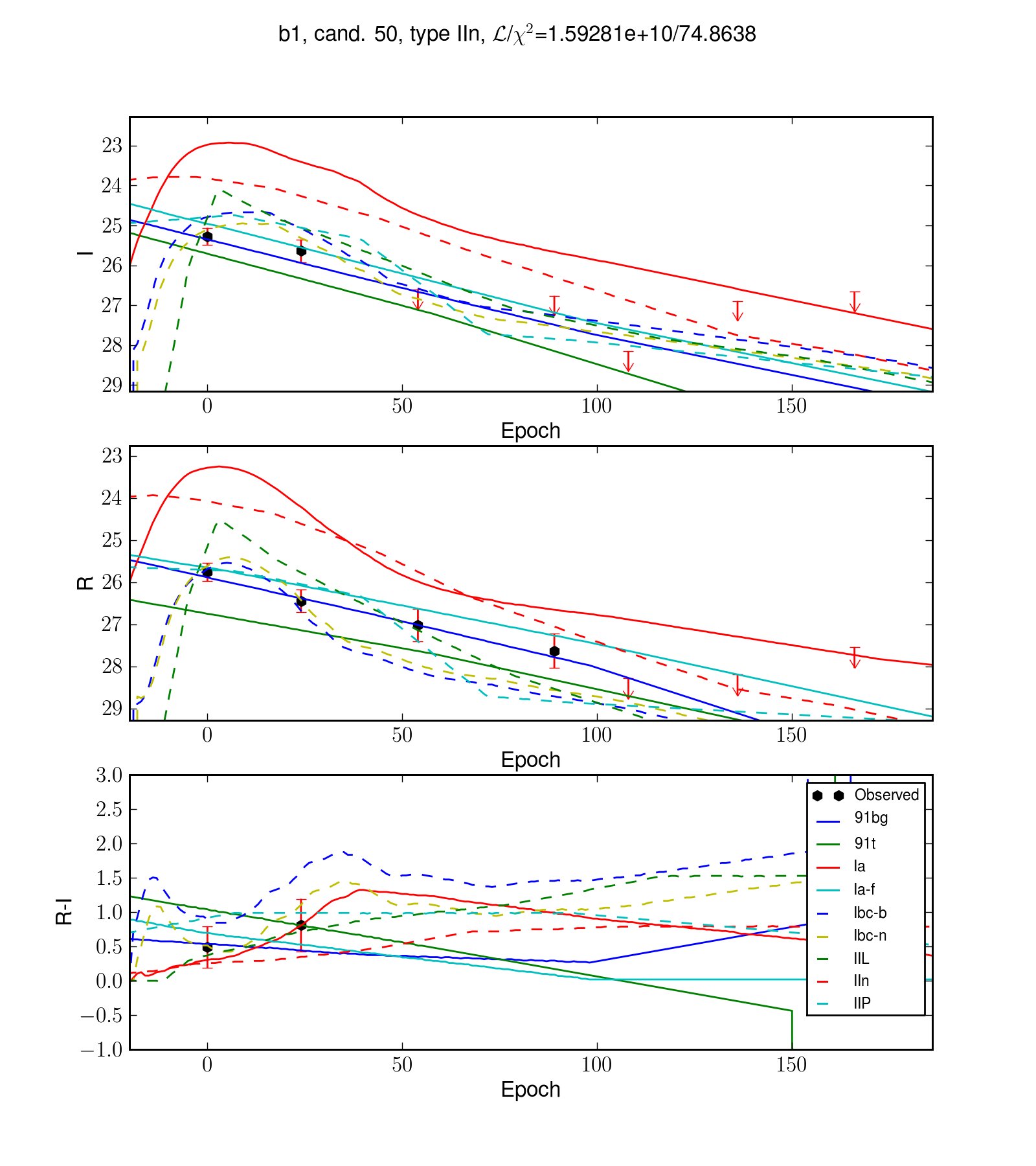
b1- 50
Type: IIn with MB(peak)=-18.64, zfit= 0.76, te= 39, extmod= 1
Quality of fit: P=0.710431, L=0.23373785E+10, Chi2= 0.11936187E+03.
Host properties: mI(host)=22.9329, zp= 0.75 (0.22)
Comment: This source is tricky. The bestfitting type (IIn) has a fairly good
likelihood, but an atrocious chisq (which is evident by looking at the
curve). The source is also negative in the last 2(3) epochs in both R
and I (although quite faint). It shows nothing in the 2 year baseline
subtraction. I think the problematic fitting, together with the negative
sources indicates that this is not a SNe, but rather an AGN. Final verdict:
X.
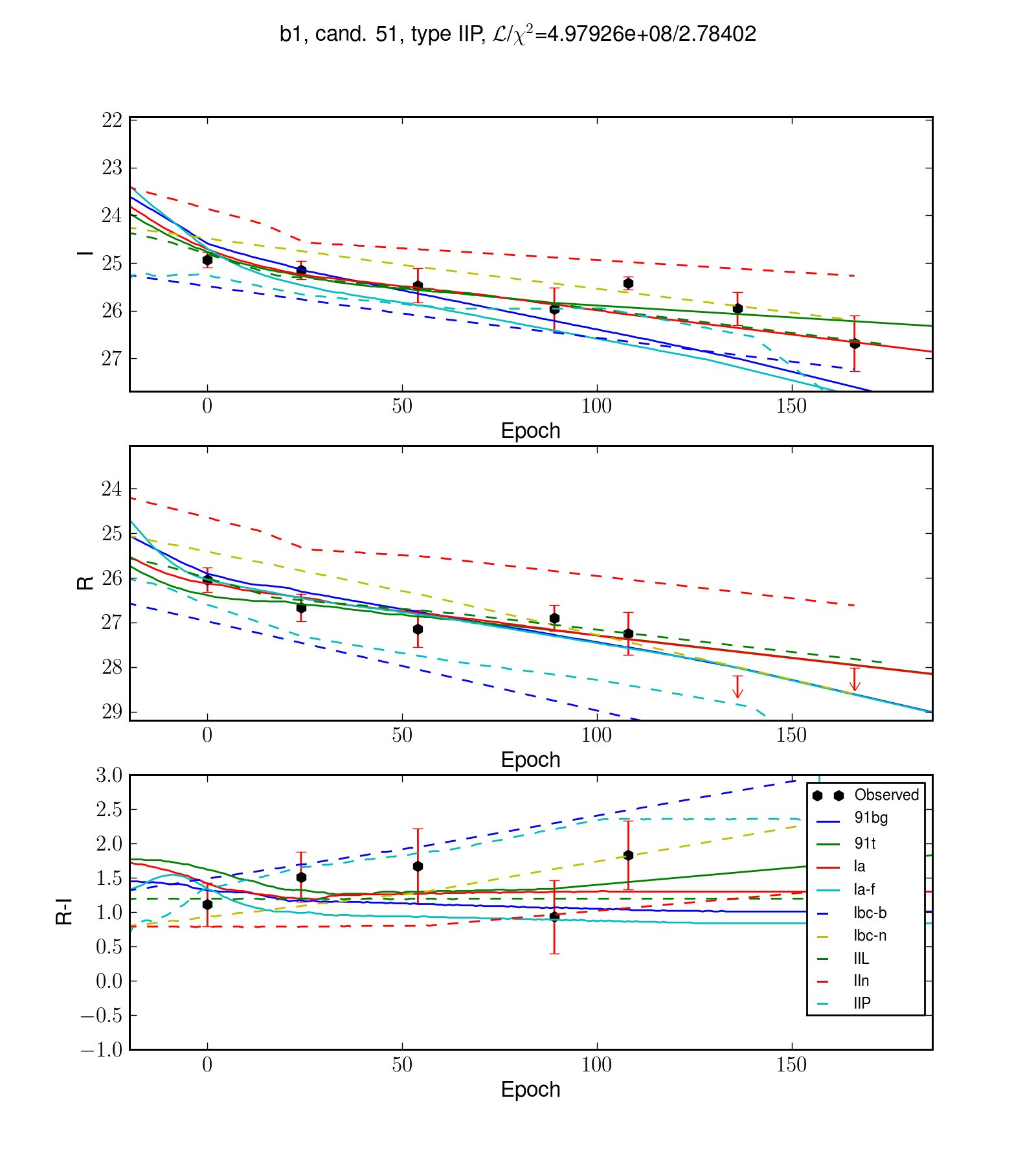
b1- 51
Type: IIP with MB(peak)=-17.65, zfit= 0.54, te= 31, extmod=14
Quality of fit: P=0.985121, L=0.49792648E+09, Chi2= 0.27840198E+01.
Host properties: mI(host)=21.2523, zp= 0.67 (0.14)
Comment: This one actually has a very weak negative feature in the 2
year baseline subtraction, and an even weaker negative feature in
the epoch 7 I band image. However, it is fitted fairly well with a
SN light curve, the caveat being epoch 5 in which the source got a
bit brighter again. This point is the reason why a IIP is preferred
(which means that the assigned redshift is quite low, and the peak
mag quite a lot brighter than the mean IIP one). This is really at
the limit of what can be accepted, but I think its more likely that
this is a SN than an AGN. Final verdict: B.
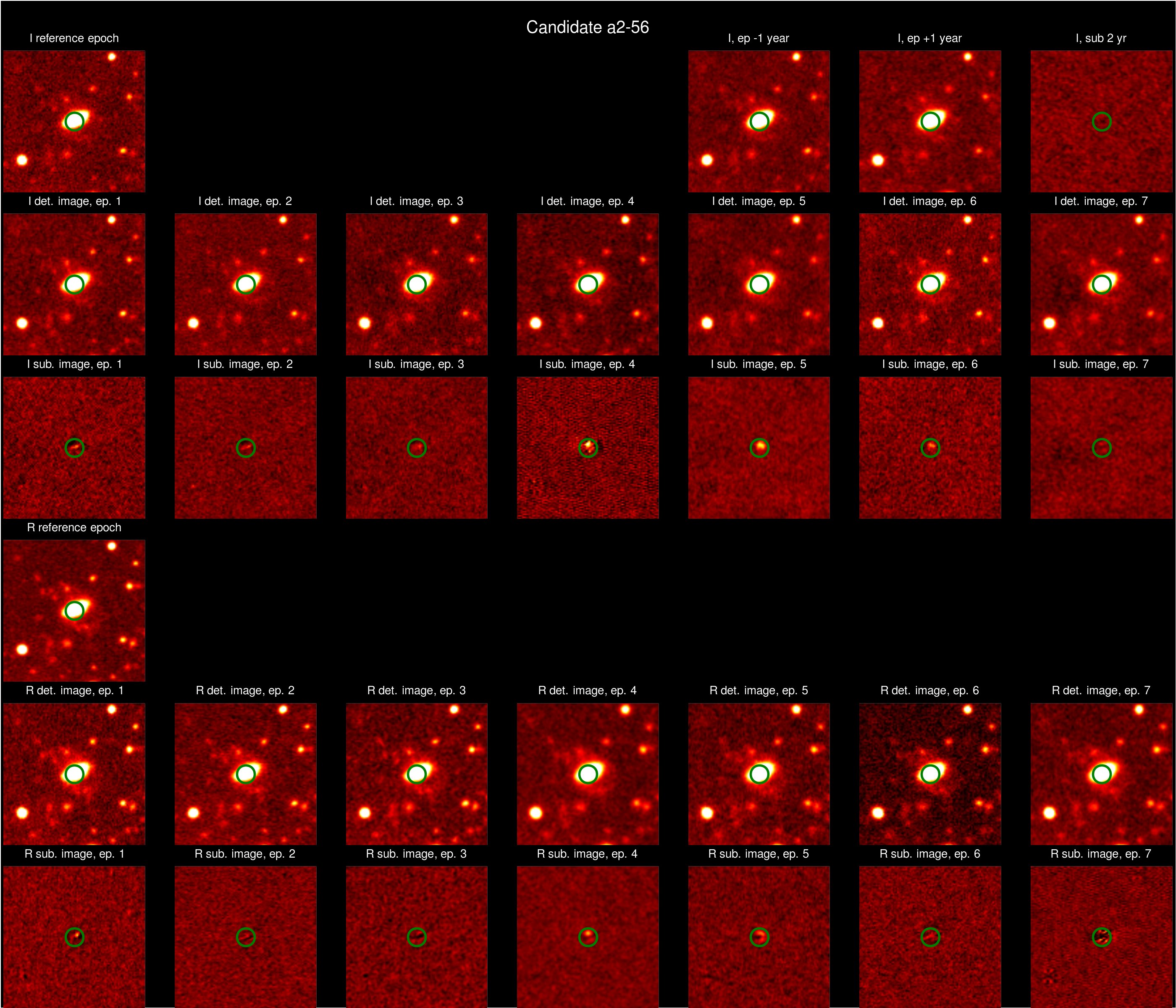
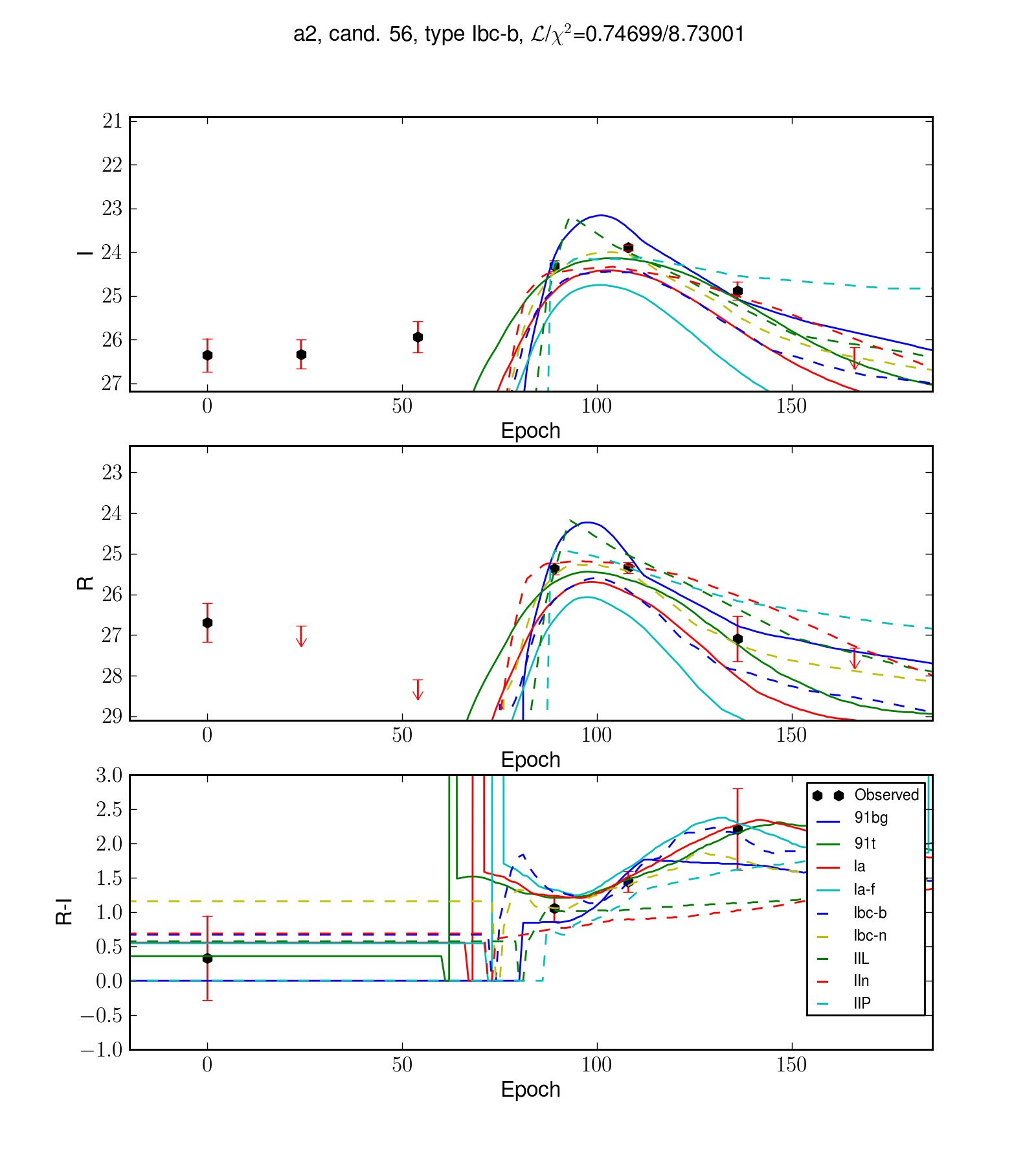
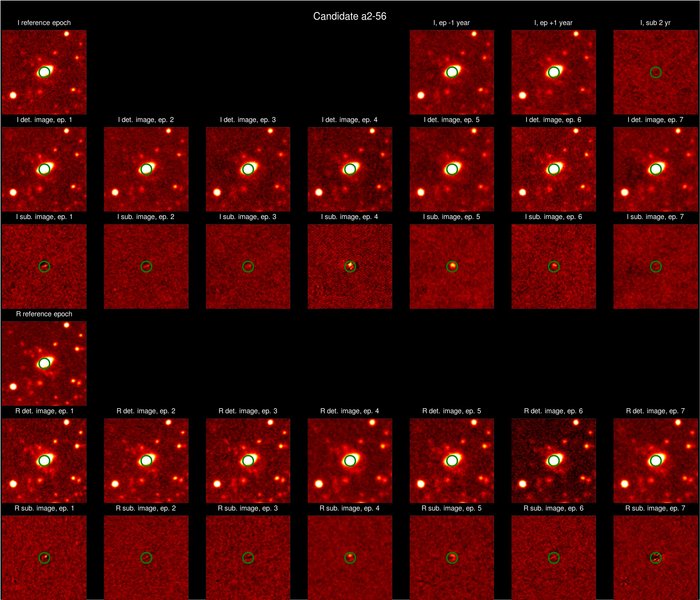
a2- 56
Type: Ibcbright with MB(peak)= -19.23, zfit=0.60, te= -73, extmod= 7
Quality of fit: P= 0.684955, L= 0.74698975E+00, Chi2= 0.87300124E+01.
Host properties: mI(host)= 20.3099, zp= 0.47 (0.18)
Comment: I think this is a SN. There are some problems with residuals
in the first epochs (in primarily I but also R) which makes the first
three data points suspect. However, in epoch four the true source
suddenly becomes brighter (or actually appears) simultaneously in
both R and I. This indicates that this is a real thing. There is
nothing to indicate that this is an AGN. The first 3 epochs might
be affecting the fit in for this source, I should probably rerun the
fitting with them treated as upper limits. Final verdict: B.
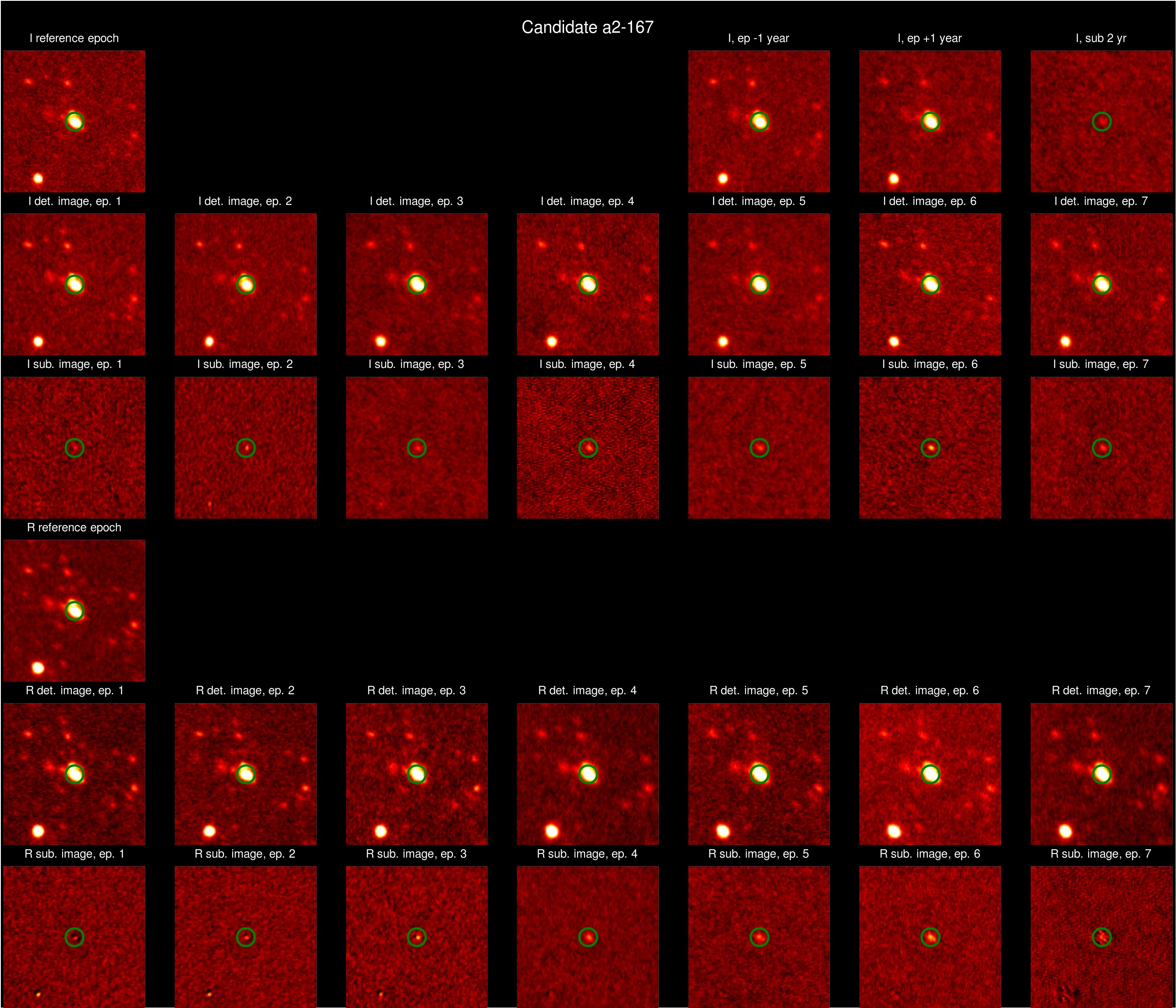
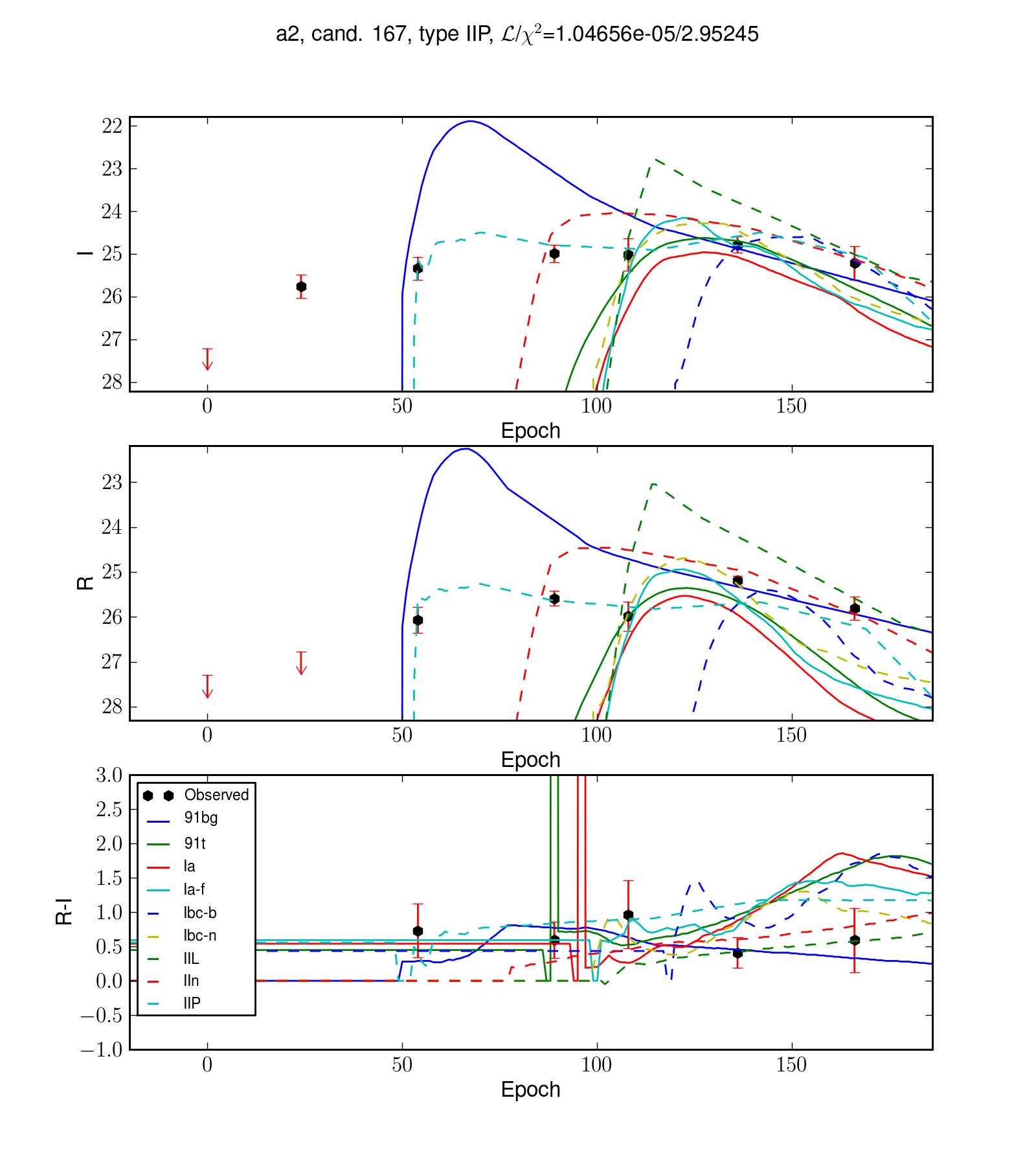
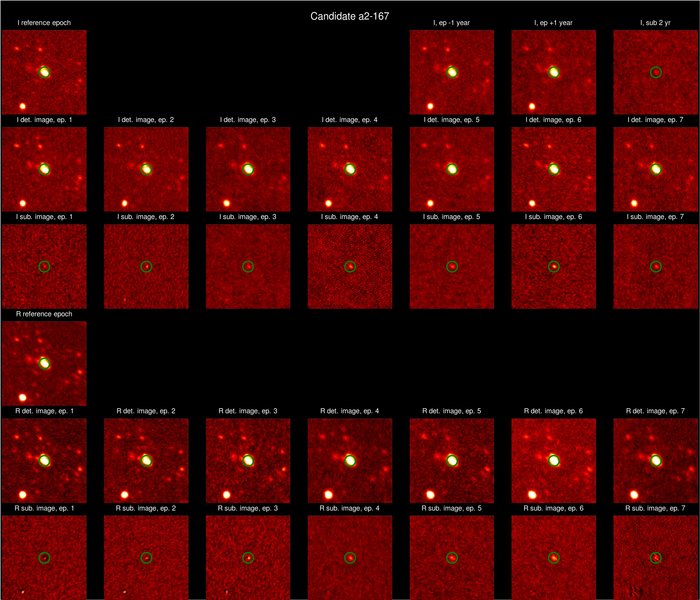
a2-167
Type: IIP with MB(peak)= -14.42, zfit=0.08, te= -49, extmod= 21
Quality of fit: P= 0.999999, L= 0.10465594E-04, Chi2= 0.29524527E+01.
Host properties: mI(host)= 22.0182, zp= 1.72 (1.46)
Comment: Clear detection in the 2-year baseline subtraction. I think this indicates that the source is an AGN. Final verdict: X.
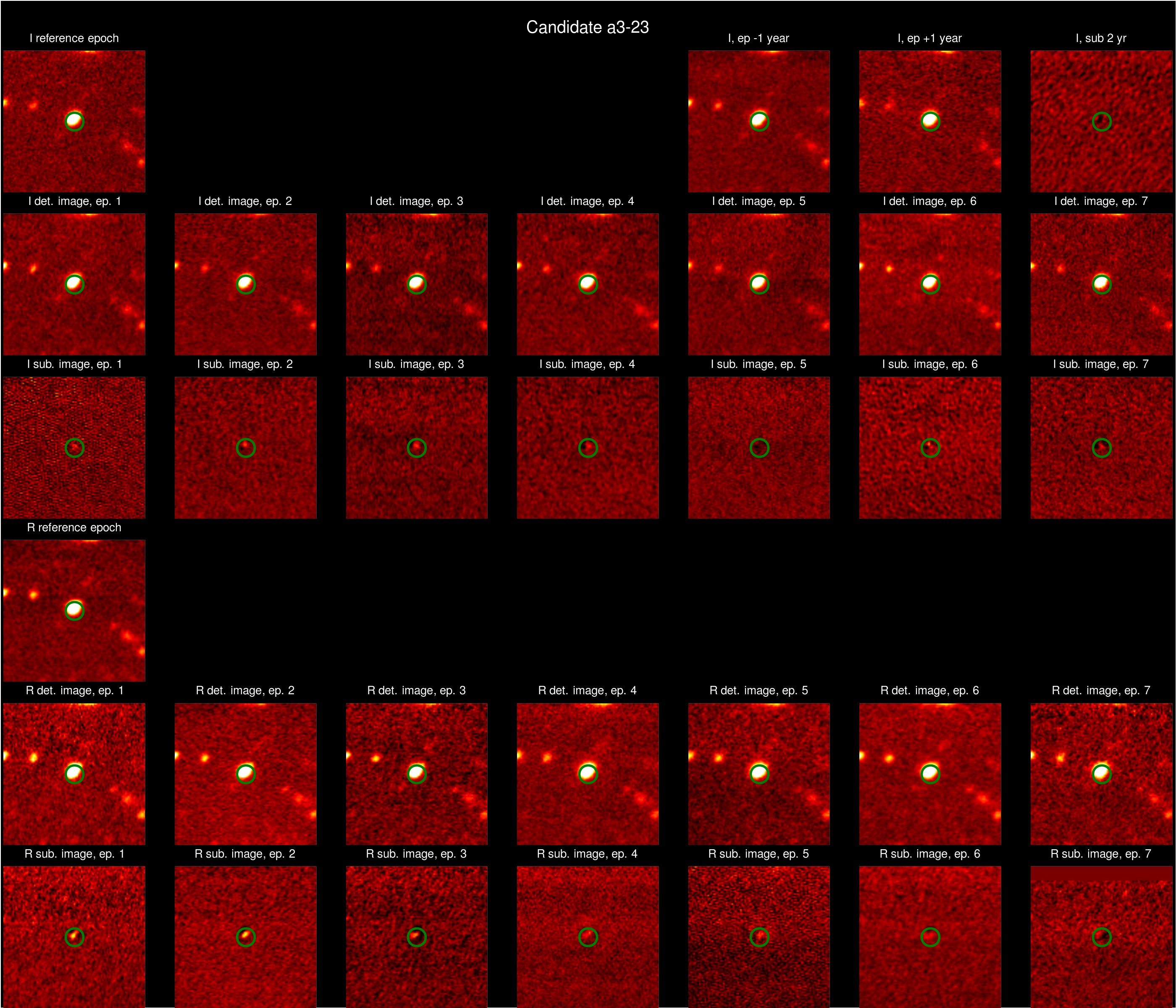
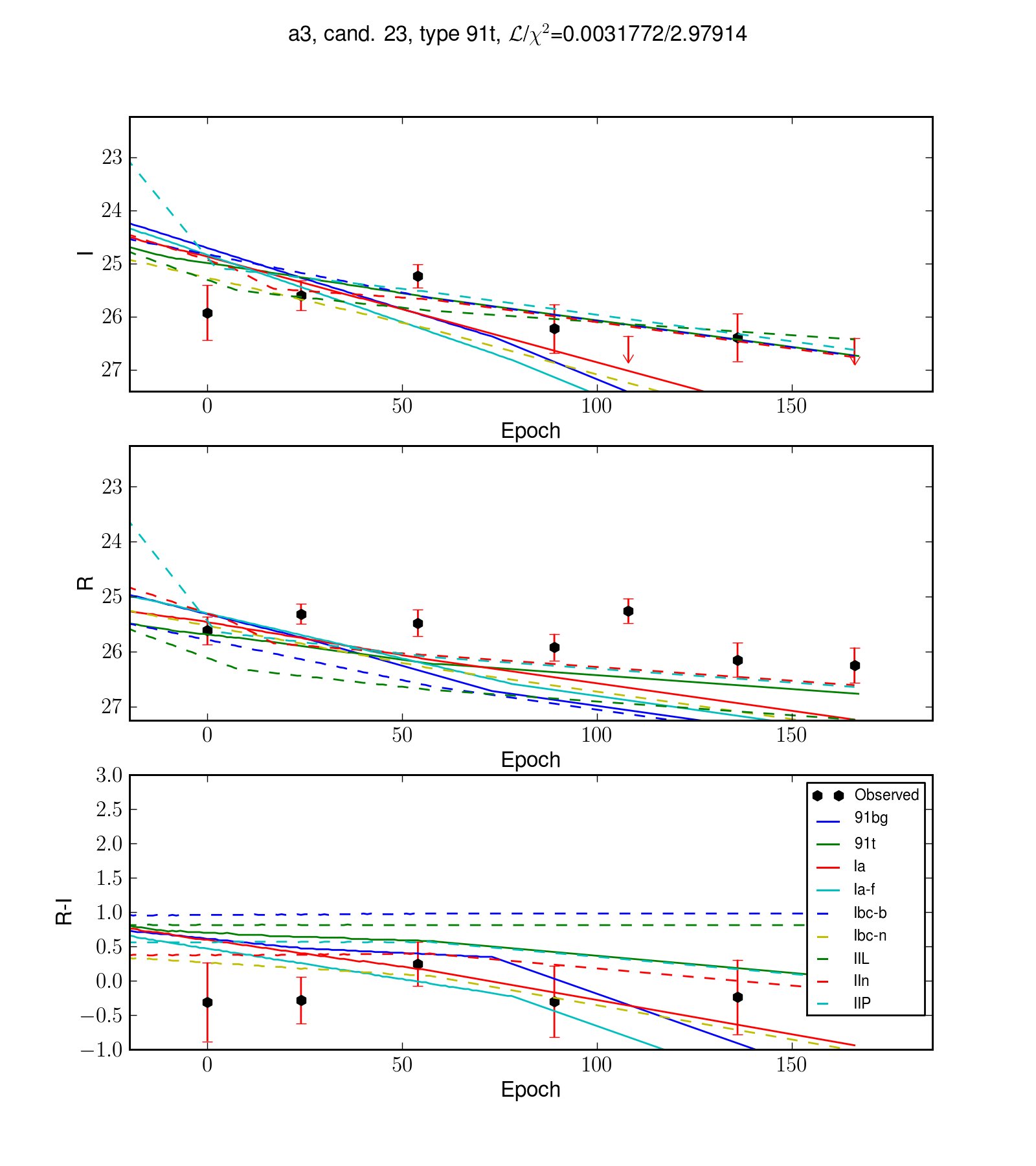
a3- 23
Type: 91t with MB(peak)= -19.84, zfit= 0.64, te= 141, extmod= 1
Quality of fit: P= 0.645455, L= 0.31771995E-02, Chi2= 0.29791376E+01
Host properties: mI(host)= 21.5613, zp=0.58 (0.50).
Comment: Very faint source, so extremely hard to say anything definite
about (let alone type, although my simulations include SNe as faint
as this so the mistyping should in principle be understood even for
sources like this). I think this is a SN. The photometry is shaky
but it just doesn't look liek a residual to me (and based on the 2
year subtraction its not an AGN). Final verdict: B.
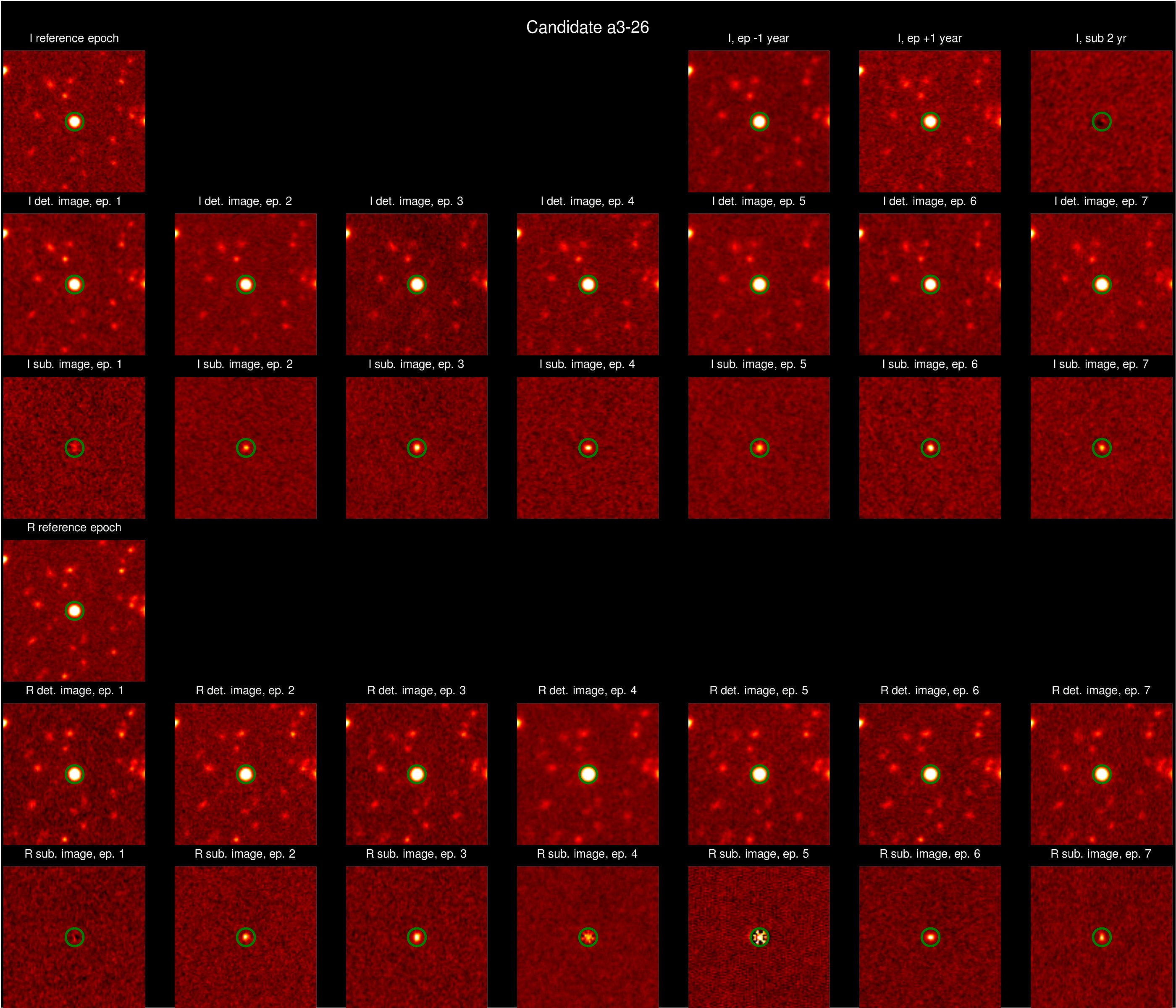
a3- 26
Type: IIP with MB(peak)= -14.42, zfit= 0.08, te= -17, extmod= 17
Quality of fit: P= 1.000000, L= 0.51966120E-52, Chi2= 0.17545867E+02
Host properties: mI(host)= 21.8209, zp=0.73 (1.20).
Comment: I don't like this one. It would be a very nice IIP candidate
but for the first I band epoch. There's a clear detection there
(~5 sigma) and that ruins the fitting completely (forcing the SN to
have low redshift and to be very faint, in order to make the observed
data point as close as possible to the model 0 flux). Performing a
fit with this point as an upper limit gives a much better fit for a
IIP at higher z (but this does not feel very ethical). All in all I
don't think that point can be disregarded, the host also has a very
high CLASS_STAR parameter making it a possibility that the source is
actually a variable star. This also fits with the colour essentially
staying constant. Final verdict: 0.