
|
2003-12-18
Gravitationally Lensed Quasar Confirms Cosmology Theory 
The discovery of a lensed quasar, which has a large separation between its components, confirms the existence of lensing objects dominated by dark matter, fully consistent with the cold-dark-matter model. Read more at Nature.com. and here.- Link to Cosmology research at the Observatory
2003-12-15
Alexis Brandeker Defends his Thesis 
On December 19, Alexis Brandeker will defend his doctoral thesis on the subject Young stars and circumstellar disks, about the environments where planets are formed. Read more about his research here. - Link to IR research at the Observatory
2003-12-03
GRB031203 Discovered by INTEGRAL 
The gamma-ray burst GRB031203 was discovered by INTEGRAL on December 03, 2003 at 22:01 UTC in the field of view of the IBIS telescope. Further information here. - Link to GRB research at the Observatory
2003-11-17
The Leonids November 13-19 
The 2003 Leonid meteor shower is set to peak on November 19. More information at leonids.com - See also astronomi.nu (Swedish)
2003-11-05
Total Lunar Eclipse November 8-9 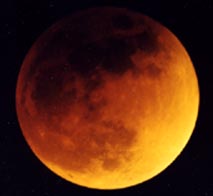
During the night between November 8 and 9 2003, a total eclipse will be visible from all of Sweden. More information at NASA - More information at astronomi.nu (Swedish)
2003-10-23
New measurements by Cassini confirm theory of relativity 
Measurements of photons to and from the Cassini spacecraft, as they pass the near the Sun, agree with the predictions of standard general relativity with a very high precision. Read more about the Cassini mission on jpl.nasa.gov - Article at physicsweb.org
2003-08-14
Mars makes a close approach 
Mars is low but bright in the night sky, and closer to earth than it's been for nearly 60 000 years. Observing Mars from Sweden, courtesy of astronomi.nu (Swedish) - Mars preview at space.com
2003-08-12
Moon makes Perseid-watching a challenge 
This year's Perseid meteor shower meets some stiff competition from the moon. More on the Perseids in Swedish at astronomi.nu - Perseid observing hints at space.com
2003-06-24
A 3-d view of the sun's surface 
New pictures from the Swedish 1-m Solar Telescope show three-dimensional detail on the solar surface. Press release on the new sun pictures - More about the Swedish 1-m Solar Telescope
2003-06-18
Gamma-ray burst = supernova 
New observations show that the universe's two biggest explosions are one and the same. Press release (in Swedish) - ESO press release
2003-05-27
Solar eclipse on May 31 
Early on Saturday morning the Moon will pass in front of the Sun. More links and information in Swedish on astronomi.nu
2003-05-13
Lunar eclipse on May 16th
Friday morning the Moon will be engulfed in the Earth's shadow. More links and information in Swedish on astronomi.nu
2003-05-05
Mercury passes in front of the sun on May 7 
Save your eyes and watch this rare transit of Mercury on the web, with pictures from the Swedish Solar Telescope, among others. Swedish Solar Telescope to observe the transit - More links and information in Swedish on astronomi.nu
2003-03-26
Can violent explosions form black holes? 
The origin of the most violent explosions known to exist in the universe, so called gamma-ray bursts, has been a long standing issue in modern astronomy. New observational data indicate a link with the death of massive stars that ultimately produces a black hole. Chandra observations of GRB020813 - Article in Nature - Research on gamma-ray bursts at Stockholm observatory - Supernova research at Stockholm observatory
2003-02-26
The death struggle of Sun-like stars 
The image shows stellar light scattered in a shell around the red giant U Antliae. The star is undergoing a period of eruptive mass loss. The shell was ejected about 3600 years ago. (Taken from the PhD thesis of David González Delgado at Stockholm Observatory). Research at Stockholm observatory involving late stellar evolution.
2003-02-22
Odin celebrates two years in space 
Swedish-built space telescope Odin has spent two successful years observing molecules in star-forming clouds. More on Odin at the Swedish National Space Board
2003-03-07
Open house at AlbaNova Sunday 9/3 at 13-17 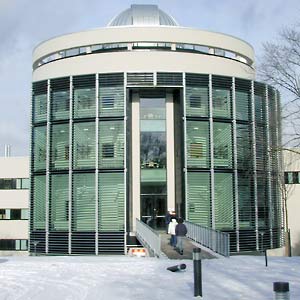
The Natural and Technical Sciences 2003 inauguration will take place at AlbaNova on Sunday, March 9. Inauguration at AlbaNova (in Swedish) - Public Outreach at Stockholm Observatory
2003-02-12
The oldest light in the Universe 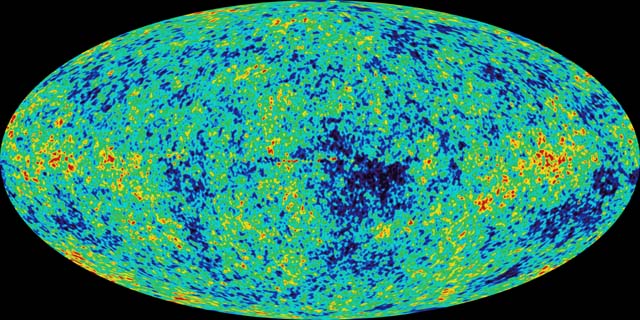
New observations support the Big Bang theory and suggest that the Universe will expand forever. (Photo: NASA/WMAP Science team). Read more about WMAP - Article at CNN - Research on the early Universe at Stockholm Observatory
2003-01-12
An asteroid named after Saltsjöbaden 
More on Saltis and its discovery by Alexis Brandeker (in Swedish)
2003-02-07
Rho Cassiopeiae: The next supernova in the Milky Way? 
The hypergiant Rho Cassiopeiae's days are numbered and it can explode as a spectacular supernova at any time. Its final death struggle is closely followed by astronomers around the world. Read more about Rho Cassiopeiae at ScientificAmerican.com - See previous news on the threat from supernovae - Supernova research at Stockholm Observatory
2003-01-10
Automatic telescope catches a "dark" GRB 
Press release from KAIT - Report in Space Daily - High energy astrophysics at Stockholm Observatory |